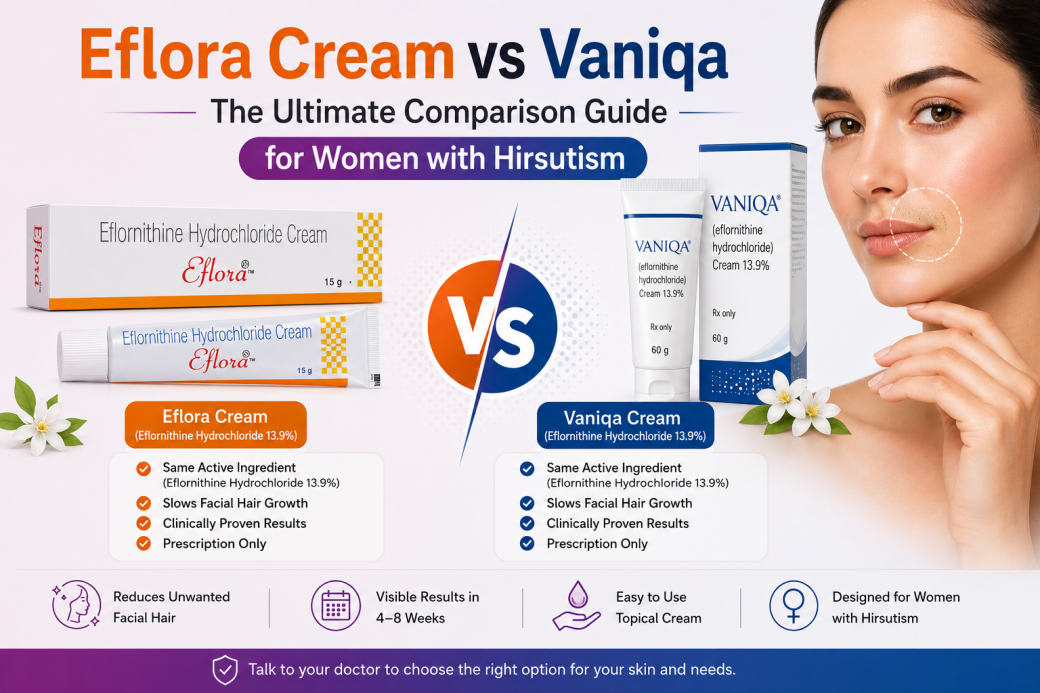
Unwanted facial hair is one of the most emotionally taxing symptoms of hirsutism, and for years, women have turned to topical creams as a non-invasive way to manage it. Two names dominate this conversation: Vaniqa and Eflora Cream. If you’ve been researching options, you’ve probably noticed these two products mentioned side by side constantly — and for good reason. They’re built on the same science. This guide breaks down exactly how they compare, so you can make an informed decision with your dermatologist.
What Is Hirsutism, and Why Do Creams Like These Exist?
Hirsutism is the medical term for excessive, male-pattern hair growth in women, typically appearing on the face, chin, upper lip, and jawline. It’s often linked to hormonal imbalances such as polycystic ovary syndrome (PCOS), elevated androgen levels, certain medications, or genetic predisposition. While it’s not dangerous, it can significantly affect self-esteem and quality of life.
Traditional hair removal methods — shaving, waxing, threading, plucking — only address the visible hair, not the growth process itself. That’s where eflornithine-based creams come in. Rather than removing hair, they work at the follicular level to slow the rate at which new hair grows, which is a fundamentally different approach from anything you’d find at a salon.
The Core Truth: They’re the Same Active Ingredient
Here’s the most important thing to understand before comparing prices, packaging, or availability: Eflora Cream is a generic version of Vaniqa and contains eflornithine hydrochloride 13.9%, the exact same active ingredient in the same strength. This isn’t a “similar” formula or a different mechanism dressed up under another name — it’s chemically identical.
Vaniqa belongs to a class of medications called ornithine decarboxylase (ODC) inhibitors, and it works by blocking the ODC protein in the skin to slow down hair growth. Eflora uses this same mechanism. The action of Eflora cream is identical to that of Vaniqa, and it’s often marketed as a Vaniqa alternative or analogue.
So when people ask “which one works better,” the honest answer is: neither, because they’re the same drug. The differences that actually matter are practical ones — availability, cost, and where you’re buying from.
How Eflornithine Actually Works
Understanding the mechanism helps set realistic expectations. The hair growth inhibitory activity of eflornithine increases when used alongside other hair removal methods like threading and waxing, and it works by penetrating to the base of the hair follicle to reduce new hair growth. Specifically, it interferes with an enzyme responsible for hair growth during the active growth phase of the hair cycle.
Crucially, neither cream removes existing hair. It may make unwanted facial hair finer and lighter over time, but it will not remove hair or cause it to fall out on its own. This is a distinction that trips a lot of first-time users up — you’ll still need your normal hair removal routine (shaving, waxing, laser, etc.) alongside the cream, at least initially.
A Major Availability Shift You Need to Know About
If you’re in the United States, there’s a significant development worth flagging: Vaniqa was discontinued in 2023, and an alternative medication with the same active ingredient, sold under the brand name Florexa, is now available instead. This discontinuation is part of why generics like Eflora have become so prominent in online searches and pharmacy conversations — the original brand simply isn’t as easy to find as it once was.
This shift also explains real-world pricing complaints. One patient review captured it well: a pharmacist told her the original Vaniqa cream was on back order and cost over $200, but she found the generic eflornithine version for about $35 instead, and it worked perfectly. That kind of price gap is consistent with what most users report.
Cost Comparison
Price is often the deciding factor for women who need to use these creams long-term (and eflornithine is very much a long-term commitment, not a quick fix). Eflora is generally more affordable and easier to find, especially since Vaniqa has become less widely available in its original form.
This pattern is consistent across multiple sources. Many users have found Vaniqa cream prices to be higher than those of Eflora cream, and the primary distinction between the two products comes down to packaging and pricing rather than effectiveness. If cost is a major concern for you — and given that this is a daily, indefinite treatment, it usually is — that price gap can add up to hundreds of dollars a year.
How Long Until You See Results?
Patience is essential with eflornithine creams, regardless of brand. Based on clinical and user-reported timelines, here’s what to realistically expect:
Visible thinning typically begins around 4 to 8 weeks of consistent use, with the fuller benefit becoming apparent between 12 and 16 weeks. Results tend to plateau after that point, and continued use is what maintains them — stopping treatment allows regrowth to resume within about 8 weeks. This means eflornithine isn’t a one-time fix; it’s an ongoing maintenance therapy, similar to how you’d approach a long-term skincare regimen rather than a single procedure.
One genuine, encouraging user account echoes this timeline: a woman who’d been shaving her upper lip, chin, and neck daily reported that after one month of use, she didn’t see changes immediately (it took about three weeks), but eventually she went from shaving daily to being able to go three or four days without shaving, with regrowth too short to be visible even when she could feel some hair.
Application Guidelines (Applies to Both)
Since the formulations are identical, the application instructions are essentially interchangeable between Eflora and Vaniqa/Florexa:
Apply twice daily, with at least 8 hours between applications, to clean, dry skin. Avoid washing the treated area for about 4 hours after application to give the formula time to absorb properly. Usage should be limited to the face and the area under the chin — these creams are not designed for body-wide hair reduction.
Who Should (and Shouldn’t) Use Eflornithine Creams
Eflornithine creams are formulated specifically for adult women dealing with unwanted facial hair on the upper lip, chin, or jawline, and they tend to work best when combined with another hair removal method, such as shaving, waxing, or laser treatments, rather than used in isolation.
That said, they’re not appropriate for everyone. Pregnant or breastfeeding women, children under 12, and anyone with a known allergy to eflornithine should avoid these products. They’re also not designed for use on broken or irritated skin, large body areas, or as a standalone hair removal solution — they slow growth, they don’t strip hair away.
As with any prescription-strength topical, a conversation with a dermatologist before starting treatment is the right move, both to confirm that hirsutism is the correct diagnosis (rather than a hormonal issue requiring separate treatment) and to rule out any contraindications specific to your medical history.
Side Effects to Watch For
Eflornithine is generally well-tolerated, but like any topical medication, it can cause side effects in some users. Potential side effects include acne and skin stinging, particularly in the early weeks of use as your skin adjusts. Most mild reactions tend to improve over time, but if irritation persists or worsens, it’s worth checking in with whoever prescribed or recommended the treatment.
Eflora vs Vaniqa: The Bottom Line
If you strip away the marketing and branding, the comparison comes down to this: Eflora and Vaniqa (or its current U.S. successor, Florexa) deliver the same eflornithine hydrochloride 13.9% formula, working through the identical ODC-inhibiting mechanism, on the same realistic timeline of 8–16 weeks for noticeable results. Neither is a permanent hair removal solution, and both require indefinite, consistent use to maintain results.
The practical differences are about access and cost, not efficacy. Vaniqa’s 2023 discontinuation in the U.S. created real availability gaps, which generic options like Eflora have stepped in to fill, often at a noticeably lower price point. For many women, that combination of equivalent results at a fraction of the cost makes the generic the more sensible choice — provided it’s sourced from a reputable pharmacy and used under appropriate medical guidance.
Whichever option you choose, the most important factors for success are consistency (twice-daily application, every day, for months) and realistic expectations: this is a hair-growth slowdown tool, not a hair-removal tool. Pairing it with your existing hair removal routine, rather than replacing it entirely, tends to produce the visible difference most women are looking for.
This article is for informational purposes only and is not a substitute for professional medical advice. Consult a dermatologist before starting any hirsutism treatment to confirm it’s appropriate for your specific health situation.