
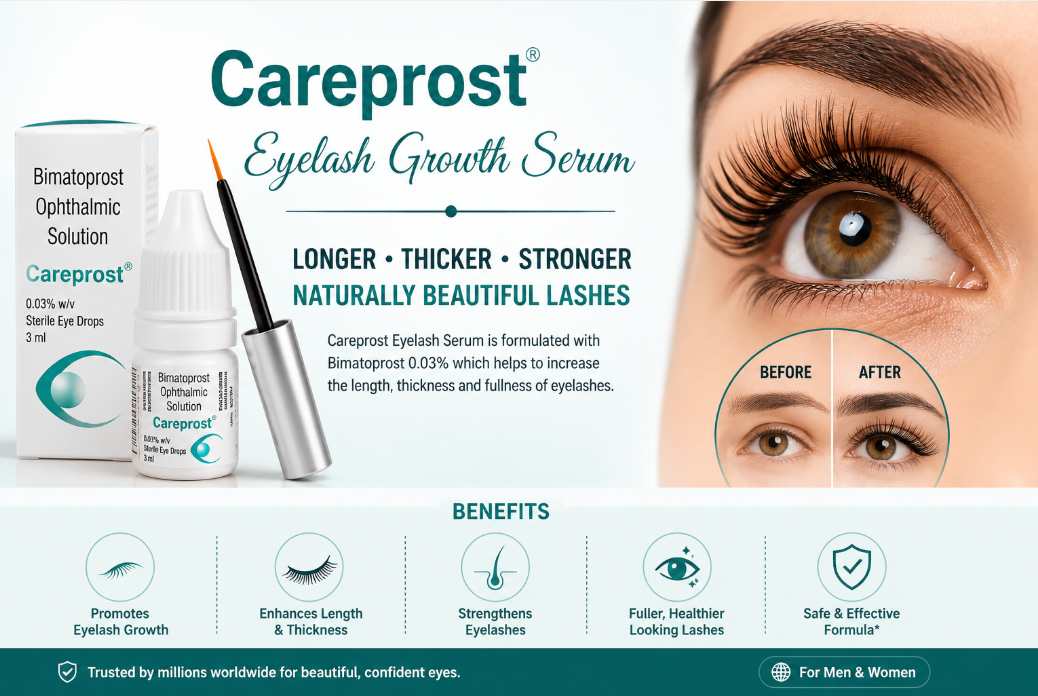
Long, thick, dark eyelashes are one of those beauty goals that mascara and false lashes can fake temporarily but rarely deliver permanently. That’s where Careprost eyelash growth serum comes in — a prescription product that has become one of the most talked-about options for genuinely growing longer, fuller, darker lashes rather than just enhancing the ones you already have.
Careprost’s backstory is a little unusual: it wasn’t originally developed for eyelashes at all. It started as a glaucoma medication, and its lash-boosting effect was discovered almost by accident. Here’s everything you need to know about how it works, what results to expect, and the side effects worth understanding before you start.
What Is Careprost?
Careprost is a topical ophthalmic solution whose active ingredient is bimatoprost 0.03%, a synthetic prostaglandin analogue. It’s the generic equivalent of two well-known branded products: Lumigan, prescribed for glaucoma, and Latisse, the FDA-approved eyelash growth treatment.
Bimatoprost was originally developed and approved to treat open-angle glaucoma and ocular hypertension, conditions involving elevated pressure inside the eye that can damage the optic nerve over time. During clinical use for this purpose, doctors and patients noticed a striking side effect: eyelashes were growing longer, thicker, and darker. That observation eventually led to bimatoprost being formulated and approved specifically as a cosmetic eyelash treatment.
Today, Careprost is used for two distinct purposes:
- Medical use: lowering intraocular pressure in glaucoma and ocular hypertension
- Cosmetic use: treating hypotrichosis (inadequate or sparse eyelashes) and general eyelash enhancement
Because it’s a prescription-only product in most countries — including the UK, US, and India — it should be used under medical guidance, particularly for its cosmetic application around such a sensitive area as the eyes.
How Does Careprost Work?
Eyelashes, like scalp hair, grow in cycles that include a growth phase, a resting phase, and a shedding phase. Bimatoprost is thought to work by extending the active growth phase of the eyelash hair cycle and increasing the number of hairs that enter that growth phase at once. The result is lashes that grow longer, appear thicker and fuller, and often darken in colour.
Unlike cosmetic lash serums built around peptides or conditioning ingredients, bimatoprost has a direct pharmacological effect on the hair follicle, which is part of why its results tend to be more dramatic — and why it comes with a more serious side effect profile than typical over-the-counter lash serums.
What Is Careprost Used For?
Medical Use
Careprost’s original and most clinically established use is for managing elevated eye pressure in:
- Open-angle glaucoma
- Ocular hypertension
In these cases, it works by increasing the outflow of fluid (aqueous humour) from the eye, helping to protect the optic nerve from pressure-related damage.
Cosmetic Use
Careprost’s more popular application today is for:
- Hypotrichosis — a medical term for inadequate, sparse, or thin eyelashes
- General eyelash enhancement — for those who simply want longer, fuller, darker lashes without extensions, falsies, or daily mascara
This cosmetic use has made Careprost a popular (if unconventional) alternative to salon lash treatments, largely because of its lower cost compared to prescription brand-name options like Latisse.
How to Use Careprost for Eyelash Growth
Correct application matters for both effectiveness and minimising side effects, since bimatoprost is a potent active ingredient applied close to the eyes.
- Remove all makeup and contact lenses before application. If you wear contacts, they should stay out for at least 15 minutes after application, since the FDA has noted that lenses can absorb the solution.
- Wash your face and hands thoroughly to avoid introducing bacteria near the eyes.
- Apply one drop of the solution to the specially provided applicator brush (never use a standard eyeliner or mascara brush unless the product instructs otherwise).
- Draw a thin line along the base of the upper eyelash line, similar to applying eyeliner, staying close to the roots of the lashes.
- Do not apply to the lower lash line or inside the eye — Careprost is only intended for the skin at the base of the upper eyelid margin.
- Blot any excess solution with a clean tissue to prevent it from spreading to unintended areas of skin, which can cause unwanted hair growth elsewhere.
- Use once nightly, consistently, as directed by your prescriber.
- Discard the applicator after each use if using single-use brushes, to reduce the risk of contamination.
Consistency is key — skipping applications or using it irregularly significantly slows down and limits results. It’s also important to note that using more product does not speed up results; excess application only increases the risk of side effects without improving outcomes.
Careprost Results: What to Expect and When
Bimatoprost doesn’t work overnight, and patience is part of the process. Based on clinical experience and available research, a general timeline looks like this:
- Weeks 1–4: Early, subtle changes may begin, though visible results are often minimal at this stage
- Weeks 8–12: Noticeable improvements in lash length, thickness, and darkness typically start to appear
- Weeks 12–16: Many users report reaching their fullest, most dramatic results within this window
Full results generally require 3 to 4 months of consistent, nightly use. Once you stop using Careprost, lash growth is not permanent — over several weeks to months after discontinuation, lashes typically return to their original length and thickness as the growth-stimulating effect fades. Many users choose to move to a maintenance schedule, applying the serum two to three times per week, once their desired results are achieved.
Benefits of Careprost Eyelash Serum
- Genuine hair growth, not just enhancement — unlike mascara or extensions, bimatoprost changes the actual growth cycle of the lash follicle
- Longer, thicker, and darker lashes with consistent use, as demonstrated across clinical research on bimatoprost
- Backed by extensive clinical data — bimatoprost’s safety for therapeutic use has been studied in dozens of clinical trials involving thousands of glaucoma patients over more than two decades
- Dual-purpose formulation — for patients who also have glaucoma or ocular hypertension, it can address both eye pressure and lash growth
- Cost-effective alternative — Careprost, as a generic bimatoprost formulation, is typically far less expensive than brand-name options like Latisse, while containing the same active ingredient and concentration
Side Effects of Careprost
Because Careprost is applied so close to a sensitive area, understanding its side effect profile is essential before starting treatment.
Common, Usually Mild Side Effects
- Itching or redness around the eyelids
- Dryness or irritation of the eyelid skin
- Mild eye redness or bloodshot appearance
- Watery eyes or mild eye discomfort
These effects are common in the early weeks of use and often subside as the skin adjusts. A cold compress can help ease discomfort, and reducing application frequency temporarily may also help if irritation is bothersome.
Less Common but Notable Side Effects
- Darkening of the eyelid skin — usually temporary and tends to resolve after stopping use, though it can take time
- Darkening of the iris (eye colour change) — a rare but recognised effect of prostaglandin analogues like bimatoprost, particularly with long-term use; this change may be permanent in some cases, which is one reason ophthalmologist supervision is important
- Unwanted hair growth in unintended areas — if the solution spreads beyond the lash line (for example, onto surrounding skin), it can stimulate hair growth in those areas as well
- Eye or eyelid swelling
Serious Side Effects (Rare, but Require Immediate Attention)
- Allergic reactions — including rash, hives, swelling of the face, lips, tongue, or throat
- Eye pain, infection symptoms, or sudden vision changes
- Significant or worsening eye redness that doesn’t improve
If you experience any of these more serious symptoms, stop use and contact your healthcare provider or ophthalmologist promptly.
Who Should Avoid Careprost
- Anyone with a known allergy to bimatoprost eye drops or other ingredients in the formulation
- People with active eye infections or inflammation
- Those who are pregnant or breastfeeding, unless a doctor determines the potential benefit outweighs the risk — human safety data in these groups is limited
- Individuals under the age recommended by the product labelling (commonly 16 and under, depending on regional guidelines)
- Anyone using other ophthalmic medications without first spacing out application times appropriately, as advised by a doctor
Tips for Safer, More Effective Use
- Always use as prescribed — nightly application to the upper lash line only, never inside the eye or on the lower lash line
- Be patient — meaningful results take months, not weeks, and inconsistent use will delay or diminish outcomes
- Watch for eye colour changes, especially if you have light-colored eyes, and report any changes to your prescriber promptly
- Don’t share applicators between eyes or with other people, to avoid cross-contamination
- Keep contact lenses out during and for at least 15 minutes after application
- Get periodic checkups if using Careprost long-term, particularly if you’re also using it for glaucoma management, so your doctor can monitor eye pressure and any pigment changes
Frequently Asked Questions
Is Careprost the same as Latisse? Careprost and Latisse both contain bimatoprost 0.03% as the active ingredient. Careprost is a generic version, generally sold at a lower cost, while Latisse is the FDA-branded product specifically marketed for eyelash growth.
How long do results last after stopping Careprost? Results are not permanent. After discontinuing use, eyelashes generally return to their original length and thickness over several weeks to months as the growth-stimulating effect wears off.
Can Careprost change my eye colour? In rare cases, prostaglandin analogues like bimatoprost have been associated with increased pigmentation of the iris, which can be permanent. This is an uncommon but recognised risk, and it’s worth discussing with your doctor before starting treatment, especially for long-term use.
Is it safe to use Careprost if I don’t have glaucoma? Yes, Careprost is commonly prescribed purely for cosmetic eyelash enhancement in people without glaucoma. However, it remains a prescription medication and should be used under appropriate medical guidance.
Can I apply Careprost to my eyebrows? Careprost is formulated and approved specifically for eyelash use. While some people have experimented with similar bimatoprost products for eyebrow growth, this is off-label and not something to pursue without consulting a doctor first.
What happens if the serum gets in my eye? Getting a small amount in the eye is not typically dangerous, but excess exposure can increase the risk of irritation. If you experience persistent discomfort, redness, or vision changes, contact your doctor.
The Bottom Line
Careprost stands out from the crowded world of eyelash serums because it’s built on bimatoprost — a clinically studied, pharmacologically active ingredient with a genuine effect on hair growth, not just a cosmetic-grade conditioning formula. For people with sparse or thin lashes, it offers a real path to longer, thicker, darker eyelashes, typically visible within three to four months of consistent nightly use.
That said, its potency is exactly why it isn’t something to treat casually. Because it’s applied so close to the eyes and carries risks like eyelid pigmentation changes and, rarely, permanent iris darkening, Careprost should only be used with a valid prescription and under the guidance of a healthcare provider or ophthalmologist — someone who can assess whether it’s the right choice for you and monitor your eyes throughout treatment.
This article is for general informational purposes only and is not a substitute for professional medical advice. Always consult a qualified healthcare provider or ophthalmologist before starting, stopping, or modifying any prescription eye treatment.