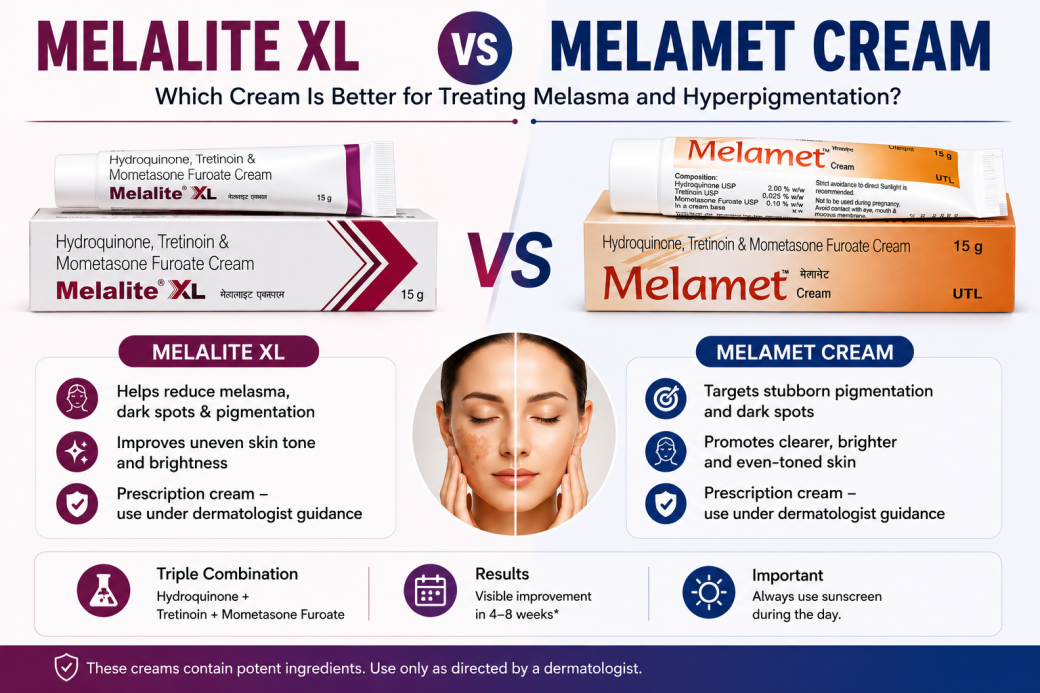
Melasma and stubborn hyperpigmentation send many people searching for the “strongest” cream they can find, and two names that come up constantly in that search — especially in India and other South Asian markets — are Melalite XL and Melamet Cream. Both are prescription-strength topical treatments, both promise visible fading of dark patches, and both are frequently recommended by dermatologists for short, supervised courses of treatment.
If you’ve been comparing the two and wondering which one is “better,” the honest answer might surprise you: they are built on almost the exact same formula. But there are still practical differences worth understanding before you or your dermatologist decides which one to use. This guide breaks down what’s actually in each cream, how they work, how they compare, and — most importantly — how to use either of them safely.
What Is Melasma and Why Is It So Hard to Treat?
Before comparing the creams, it helps to understand the condition they’re designed for. Melasma is a chronic skin disorder that causes brown, grey-brown, or bluish patches, most often on the cheeks, forehead, upper lip, nose, and chin. It’s driven by an overproduction of melanin in specific areas of skin, and it’s notoriously stubborn because it’s triggered by a combination of factors:
- Sun exposure (UV and even visible light) — the single biggest trigger and the main reason melasma keeps coming back
- Hormonal changes — pregnancy, birth control pills, and hormone therapy are classic triggers, which is why melasma is sometimes called the “mask of pregnancy”
- Genetics — people with a family history of melasma, and those with medium-to-deeper skin tones (Fitzpatrick types III–VI), are more prone to it
- Heat and inflammation — some research suggests that skin heat and irritation can also worsen pigmentation
Because melasma sits deeper in the skin than a simple sunspot, single-ingredient products often aren’t strong enough to clear it. That’s why doctors frequently turn to triple combination creams — and this is exactly the category that both Melalite XL and Melamet Cream belong to.
What’s Actually Inside Melalite XL?
Melalite XL is a prescription triple-combination cream containing three active ingredients:
- Hydroquinone (2%) – a depigmenting agent that inhibits tyrosinase, the enzyme responsible for melanin production. This is the ingredient doing most of the “lightening” work.
- Tretinoin (0.025%) – a vitamin A derivative (retinoid) that speeds up skin cell turnover, helps shed pigmented surface cells, and improves how well hydroquinone penetrates the skin.
- Mometasone Furoate (0.1%) – a mild-to-moderate topical corticosteroid that calms the inflammation and irritation the other two ingredients can cause, and helps prevent the skin from darkening further in response to that irritation.
Together, these three ingredients attack pigmentation from multiple angles at once: blocking new melanin production, clearing out existing pigmented cells, and controlling inflammation. This is the classic “Kligman’s formula” concept — a combination first developed decades ago and still considered one of the most effective topical approaches to melasma when supervised by a dermatologist.
Melalite XL is generally prescribed for short-term use — commonly over the course of a few weeks to a few months — followed by a break or a switch to a gentler maintenance regimen, because prolonged steroid use on the face carries real risks.
What’s Actually Inside Melamet Cream?
Here’s the part that surprises most people comparing these two products: Melamet Cream uses the same three active ingredients, at the same strengths:
- Hydroquinone 2%
- Tretinoin 0.025%
- Mometasone Furoate 0.1%
In other words, Melamet Cream and Melalite XL are both generic versions of the same triple-combination formula, manufactured by different pharmaceutical companies. They work through the identical mechanism: hydroquinone suppresses melanin production, tretinoin accelerates cell turnover and enhances penetration, and mometasone reduces the inflammation and irritation associated with the other two ingredients.
Because the core formula is essentially identical, it’s more accurate to think of Melalite XL and Melamet Cream as two brand-name versions of the same medicine, rather than as competing treatments with different strengths or approaches.
Melalite XL vs Melamet Cream: Side-by-Side Comparison
| Feature | Melalite XL | Melamet Cream |
|---|---|---|
| Hydroquinone | 2% | 2% |
| Tretinoin | 0.025% | 0.025% |
| Mometasone Furoate | 0.1% | 0.1% |
| Primary use | Moderate-to-severe melasma, dark spots, senile lentigines | Melasma, hyperpigmentation, dark patches |
| Prescription required | Yes | Yes |
| Typical duration of use | Short-term, dermatologist-directed | Short-term, dermatologist-directed |
| Application | Thin layer at night, on affected areas only | Thin layer at night, on affected areas only |
| Mechanism | Tyrosinase inhibition + exfoliation + anti-inflammatory | Tyrosinase inhibition + exfoliation + anti-inflammatory |
As the table makes clear, on paper, there’s no meaningful difference in ingredients, concentrations, or intended use. Any difference you notice in practice is more likely to come down to the cream’s base/vehicle (which can affect texture, absorption, and how the skin tolerates it), the manufacturer’s quality control, price, and availability — not the active pharmacology.
So Which One Should You Choose?
Given the identical active ingredients, the decision between Melalite XL and Melamet Cream often comes down to a few practical, non-pharmacological factors:
1. What your dermatologist prescribes. Since both are prescription medicines with the same formulation, your dermatologist will usually pick whichever is more consistently available, more affordable for you, or the one they have more clinical experience prescribing. There’s rarely a medical reason to specifically request one brand over the other.
2. Skin tolerance and the cream base. Even when the active ingredients are the same, the inactive ingredients (emulsifiers, emollients, preservatives) in the cream base can differ between manufacturers. Some people find one brand’s texture greasier, drier, or more irritating than another’s, purely because of the base formulation — not the actives. If one brand causes excessive stinging, peeling, or redness, switching to the other version of the same formula (with your doctor’s approval) may genuinely help simply because the base is different.
3. Price and availability. In many markets, generic pricing varies across manufacturers, and one brand may simply be easier to find at your local pharmacy than another. Given that the formulas are equivalent, price and convenience are legitimate factors to consider.
4. Batch quality and shelf life. Hydroquinone-containing creams are prone to oxidation — if the cream in the tube turns dark brown, it has degraded and lost effectiveness and should be discarded. Buying from a reputable pharmacy and checking expiry dates matters more than the brand name itself.
How to Use Either Cream Safely
Because both Melalite XL and Melamet Cream contain a potent combination of a bleaching agent, a retinoid, and a steroid, safe use matters as much as choosing the “right” brand. General guidelines dermatologists typically recommend include:
- Apply only a thin layer to the affected, pigmented areas — not the entire face — usually at night.
- Never use it longer than prescribed. Long-term steroid use on facial skin can cause thinning, visible blood vessels, rebound pigmentation, or steroid-induced acne and rosacea-like reactions.
- Use broad-spectrum sunscreen every day, since both hydroquinone and tretinoin increase sun sensitivity, and UV exposure is the single biggest driver of melasma recurrence.
- Avoid the eyes, eyelids, lips, and mucous membranes.
- Don’t use during pregnancy or breastfeeding unless specifically advised by a doctor, since both hydroquinone and tretinoin carry precautions in these situations.
- Watch for a patch test reaction before applying broadly, particularly if you have sensitive skin, eczema, or rosacea.
- Expect a gradual result. Most triple-combination regimens run 8–16 weeks before significant fading is visible, and maintenance (often with a gentler product) is usually needed afterward to prevent relapse.
Are There Alternatives Worth Knowing About?
If a dermatologist determines that a triple-combination steroid-containing cream isn’t right for you — for example, due to thin or sensitive facial skin, rosacea, or the need for longer-term maintenance — other options in the pigmentation treatment toolbox include azelaic acid, kojic acid, glycolic acid peels, non-hydroquinone brighteners like tranexamic acid or niacinamide, and in more resistant cases, procedures such as chemical peels or laser treatments. These are generally considered gentler for long-term or maintenance use, since they don’t carry the same steroid-related risks as continuous triple-combination therapy.
The Bottom Line
When it comes to Melalite XL vs Melamet Cream, there isn’t a clear “winner” in terms of effectiveness, because both creams deliver the same three active ingredients at the same strengths: Hydroquinone 2%, Tretinoin 0.025%, and Mometasone Furoate 0.1%. The real-world differences between them tend to be minor and come down to the cream’s base texture, individual skin tolerance, pricing, and local availability rather than any difference in how well they treat melasma.
The most important factor isn’t which brand you choose — it’s using either cream under proper dermatological supervision, for the correct duration, paired with daily sunscreen. Because these are potent prescription medicines containing a steroid, self-prescribing or extending use beyond what’s recommended can do more harm than good. If you’re dealing with melasma or stubborn hyperpigmentation, the best next step is a consultation with a dermatologist who can assess your skin type, the depth of your pigmentation, and any contributing factors (like hormonal changes or sun exposure patterns) before recommending Melalite XL, Melamet Cream, or an alternative treatment plan tailored to you.
This article is for general informational purposes only and is not a substitute for professional medical advice. Always consult a dermatologist before starting, switching, or stopping any prescription skin treatment.