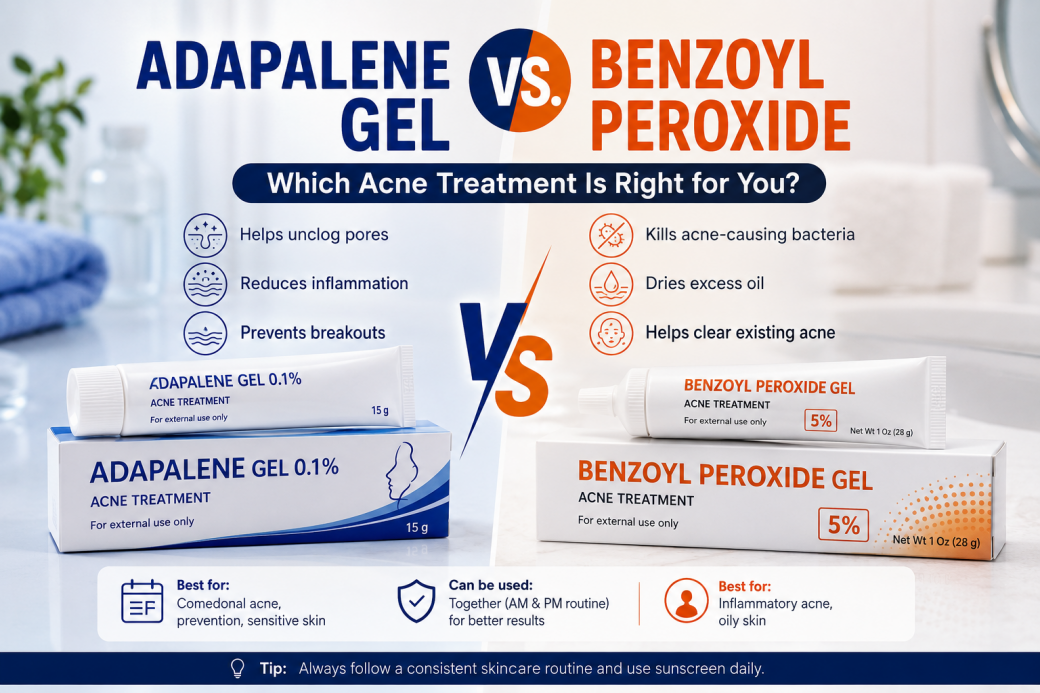
Acne is one of the most common skin concerns in the world, affecting teenagers and adults alike. Walk into any pharmacy or scroll through any skincare forum, and two ingredients come up again and again: adapalene and benzoyl peroxide. Both are backed by decades of research, available over the counter (in most countries), and genuinely work. But they work in very different ways, suit different skin types, and come with different trade-offs.
This guide breaks down how each ingredient functions, their pros and cons, and how to decide which one — or whether a combination of both — makes sense for your skin.
Understanding Acne First
Before comparing treatments, it helps to understand what actually causes acne. Breakouts typically form through a combination of four factors: excess oil (sebum) production, clogged pores from dead skin cells, bacterial overgrowth (specifically Cutibacterium acnes), and inflammation. Different acne treatments target different parts of this chain, which is exactly why adapalene and benzoyl peroxide, despite both being “acne medications,” behave so differently on the skin.
What Is Adapalene?
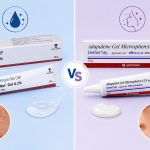
Adapalene is a third-generation retinoid — a class of compounds derived from vitamin A. It was originally available only by prescription (under brand names like Differin) but is now sold over the counter in many countries at a 0.1% concentration, with 0.3% still requiring a prescription in some regions.
How It Works
Adapalene works primarily by normalising the way skin cells shed. In acne-prone skin, dead skin cells don’t shed properly and instead clump together inside pores, forming the plugs that become blackheads, whiteheads, and eventually inflamed pimples. Adapalene speeds up cell turnover and prevents this clumping, which means it works best as a preventive treatment — stopping new clogged pores from forming in the first place, rather than treating existing pimples overnight.
It also has mild anti-inflammatory properties, which is part of why it’s effective against inflammatory acne as well as comedonal acne (blackheads and whiteheads).
Benefits of Adapalene
- Prevents future breakouts by keeping pores clear on an ongoing basis
- Improves skin texture and reduces the appearance of enlarged pores over time
- Fades post-acne marks (hyperpigmentation) gradually, since it increases cell turnover
- Reduces fine lines with long-term use, since it’s a retinoid — a nice secondary benefit for adult acne sufferers who are also thinking about aging skin
- No bacterial resistance risk, unlike antibiotics
Downsides of Adapalene
- Slow to show results. Most people don’t see meaningful improvement until 8–12 weeks of consistent use.
- “Purging” phase. Because it speeds up cell turnover, many users experience an initial worsening of breakouts in the first 2–4 weeks as clogged pores are pushed to the surface faster.
- Dryness, peeling, and irritation, especially in the first few weeks. This is often called “retinization.”
- Increases sun sensitivity, so daily sunscreen becomes non-negotiable.
- Not safe during pregnancy, as with all retinoids.
What Is Benzoyl Peroxide?
Benzoyl peroxide (BPO) is an antibacterial and mildly exfoliating compound that has been a staple of acne treatment since the 1960s. It’s available over the counter in a wide range of formulations — washes, gels, creams, and spot treatments — typically in concentrations from 2.5% to 10%.
How It Works
Benzoyl peroxide works mainly by releasing oxygen into the pore, which kills C. acnes bacteria (bacteria that cause acne generally thrive in oxygen-poor environments). It also has a mild keratolytic (exfoliating) effect, helping to clear dead skin cells, and it reduces inflammation. Because it directly targets the bacteria driving active, inflamed pimples, it tends to work faster than adapalene on existing breakouts.
Benefits of Benzoyl Peroxide
- Fast-acting. Visible reduction in active pimples often within days to two weeks.
- Kills acne-causing bacteria directly, without contributing to antibiotic resistance (unlike topical or oral antibiotics)
- Widely available in many strengths and formats, including face washes, which some people find gentler
- Effective for inflammatory acne — papules and pustules in particular
- Can be used as a short-term spot treatment on individual pimples, not just as a full-face routine
Downsides of Benzoyl Peroxide
- Bleaches fabric and hair. This is a famous side effect — white pillowcases, towels, and dark hairlines are all at risk. Many people learn this the hard way.
- Dryness and irritation, particularly at higher concentrations (10% is notably harsher than 2.5%)
- Doesn’t address the root cause of clogged pores the way a retinoid does, so it’s less useful for preventing blackheads and whiteheads long-term
- Can degrade some other ingredients, notably certain forms of vitamin C and some retinoids if mixed carelessly (adapalene itself is fairly stable with BPO, but formulation matters — see below)
- Less effective on purely comedonal (non-inflamed) acne
Adapalene vs. Benzoyl Peroxide: Side-by-Side
| Factor | Adapalene | Benzoyl Peroxide |
|---|---|---|
| Drug class | Retinoid | Antibacterial/keratolytic |
| Primary action | Normalizes cell turnover, prevents clogged pores | Kills acne-causing bacteria |
| Speed of results | Slow (8–12 weeks) | Fast (days to 2 weeks) |
| Best for | Blackheads, whiteheads, prevention, texture | Active, inflamed pimples |
| Initial purging | Common | Uncommon |
| Sun sensitivity | Increased | Minimal |
| Bleaches fabric | No | Yes |
| Pregnancy safe | No | Generally considered lower risk, but consult a doctor |
| Anti-aging benefit | Yes | No |
| Antibiotic resistance risk | None | None (kills bacteria non-selectively via oxidation) |
Can You Use Them Together?
Yes — and for many people with moderate acne, combining the two is actually more effective than using either alone, because they target different parts of the acne-formation process (cell turnover vs. bacteria). In fact, several prescription products combine adapalene and benzoyl peroxide into a single formulation (such as Epiduo) specifically because clinical studies have shown the combination outperforms either ingredient used alone.
That said, combining them requires a bit of care:
- Introduce one at a time. If you’re new to both, start with just one for a few weeks to see how your skin reacts before adding the second.
- Consider timing them separately. Some people apply benzoyl peroxide in the morning and adapalene at night, which reduces the risk of over-drying and avoids any concern about the two products interacting in the same layer.
- Moisturize generously. Both ingredients are drying, so a good fragrance-free moisturiser is essential, not optional.
- Sunscreen is mandatory. Between adapalene’s photosensitivity and benzoyl peroxide’s exfoliating effect, sun protection matters more than usual.
- Watch for irritation. Redness, peeling, and stinging are common when starting out. If irritation is severe, scale back to every other day rather than stopping altogether.
Which One Should You Choose?
There’s no universal winner — it depends on your skin and your acne pattern.
Choose adapalene if:
- Your acne is mostly blackheads and whiteheads (comedonal)
- You’re looking for a long-term, preventive solution rather than a quick fix
- You’re also interested in texture and fine-line improvement
- You’re patient enough to wait 2–3 months for full results
Choose benzoyl peroxide if:
- You have active, inflamed, red pimples that you want to calm down quickly
- You want a lower-commitment option, like a spot treatment or acne wash
- You’re not planning to change your bedding/towel habits and want to avoid bleaching risk (in which case, lower concentrations or wash-off formats help)
- You want something that works well without the sun-sensitivity concerns of a retinoid
Consider combining both if:
- Your acne includes both comedones and inflamed pimples
- You’ve tried one alone without full success
- You’re comfortable easing in slowly and monitoring for irritation
A Note on Getting Started
Regardless of which you choose, the biggest mistake most people make is going too hard, too fast. Applying a pea-sized amount every night from day one is a common way to end up with painful, red, flaking skin that makes people quit before the treatment has a chance to work. Dermatologists generally recommend:
- Starting with application every other night (or even twice a week) for the first 1–2 weeks
- Applying a thin layer only — more product doesn’t mean faster results, just more irritation
- Layering a gentle, fragrance-free moisturizer afterward
- Giving the product at least 8–12 weeks before judging whether it’s working
- Always wearing sunscreen during the day
Final Thoughts
Adapalene and benzoyl peroxide aren’t really competitors so much as two different tools for two different jobs. Adapalene is the long game — a preventive treatment that reshapes how your skin behaves over time, with bonus anti-aging perks. Benzoyl peroxide is the quick responder — an antibacterial agent that calms down active breakouts fast, without any risk of bacterial resistance.
For many people, the best acne routine isn’t a choice between the two at all, but a thoughtful combination of both, introduced slowly and paired with sun protection and a solid moisturizer. If your acne is persistent, painful, or leaving scars, it’s also worth checking in with a dermatologist — they can help tailor a routine (including prescription-strength options) to your specific skin.
This article is for general informational purposes and isn’t a substitute for personalized medical advice. If you have a skin condition, are pregnant, or are considering starting a new treatment, it’s a good idea to talk to a dermatologist or doctor first.